Two years ago today, I shared a list of 23 enslaved persons freed on 19 June 1865 by the issuance of General Order No. 3 in Texas. I meant to write so much more.
I frankly found myself overwhelmed with all the things I wanted to say and the reasons I wanted to say them. So I ultimately decided to simplify. The back story could wait. My thoughts on the momentous racial justice events of the summers of 2020 and 2021 could wait.
It felt a bit like being in the middle of a hurricane—a fitting analogy for an historic event where ground zero was Galveston. I needed to wait the storm out because I did not want these 23 people to get lost in the deluge.
And then life happened, as it does. Because I could not find the time to return to the story of these 23 people in the way I felt they deserved, I stopped blogging completely. I was paralyzed by my desire to do something meaningful. (Insert trope here about perfection being the enemy of the good.) I began working on it again a year ago. And life kept happening.
So I did not want to let yet another Juneteenth pass without picking up their story.
June 1865
A Galveston newspaper published the text of Maj. Gen. Gordon Granger’s pronouncement two days later.[1]
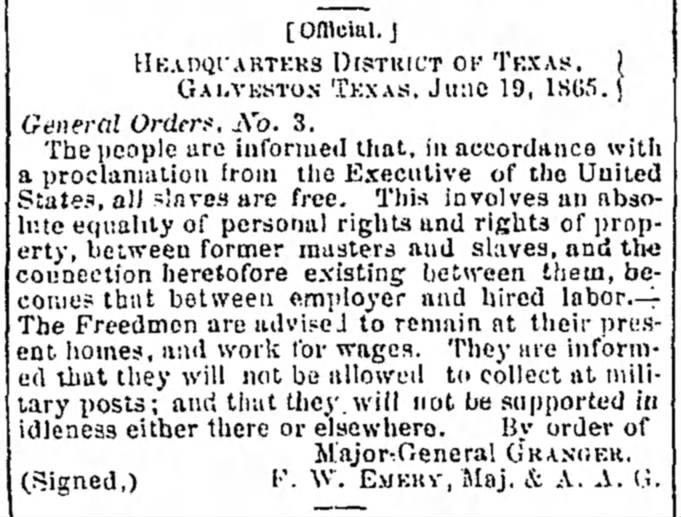
“All slaves are free,” he said. Former masters became “employers.” Formerly enslaved men and women became “hired labor.” “Idleness” would not be tolerated.
“The Freedmen are advised to remain at their present homes, and work for wages.”
July 2019
Halfway through my ProGen Study Group, an intensive preparation program for would-be professional genealogists, I embarked on an assignment to transcribe a deed or a will. I could either use one from my own research or find a new one locally.
I had long been curious about a Sansbury family who lived in Fort Bend County in the 1800s. Fort Bend lies southwest of Houston and encompasses part of the land granted to Moses Austin to help colonize the river valleys in this part of Texas.[2]
In these pre-Covid 19 days, I spent several hours each Friday volunteering at the Clayton Library Center for Genealogical Research. As a FamilySearch affiliate library, while I was there I could peruse digitized records not available to me at home. So I pulled up some Fort Bend County records and looked through an index under the letter S, hoping to find a document related to the Fort Bend Sansburys.
I did find a document for my assignment. But in the process an entry jumped out at me for a record indexed beginning with the word “Slave” rather than a surname. I downloaded the relevant images and the document landed on my nebulous “to do” list.
To be continued. (I promise it won’t be two years before the next installment!)
#juneteenth #emancipated #africanamericangenealogy
[1] “General Orders, No. 3,” The Galveston Daily News (Galveston, Texas), 21 June 1865, p. 1, https://newspapers.com, subscription database, accessed June 2022.
[2] Virginia Laird Ott for the Texas State Historical Association, “Fort Bend County,” Handbook of Texas, https://www.tshaonline.org/handbook/entries/fort-bend-county, accessed June 2023.
 The JenGenX Files
I will look forward to it! Sounds like a story needing to be told.
LikeLike